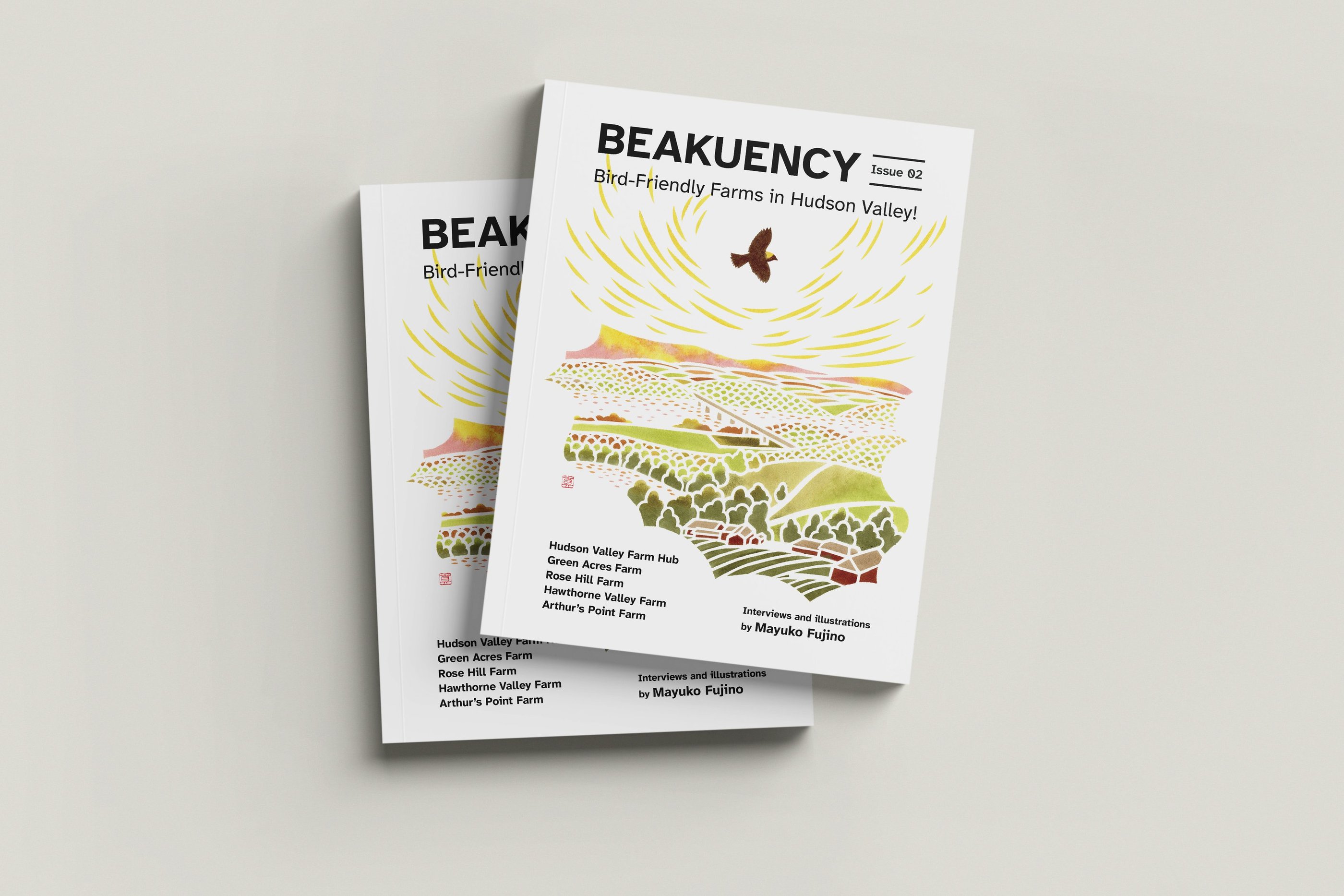
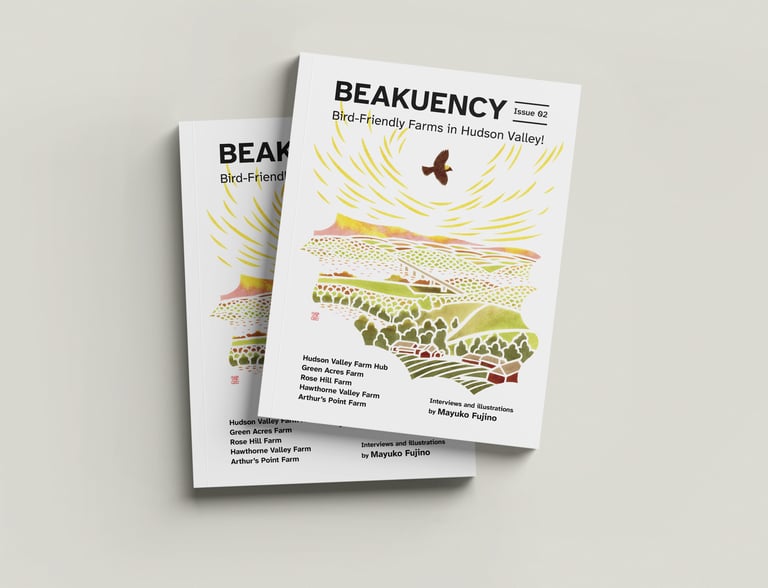
Beakuency: Bird-Friendly Farms in Hudson Valley!
There is often tension where working lands meet birdlife. But it doesn’t have to end in conflict. Through interviews at five innovative Hudson Valley farms, learn how farmers and naturalists collaborate to wisely balance human needs with conservation. Using science to establish practical paths forward, and considering all elements as part of a larger picture, they show us what a positive relationship between people and land can look like. Their insights reach well beyond agriculture into life — sitting with uncertainty, resisting shortcuts, and choosing coexistence. It is up to us, as community members, to follow their lead and support the change we want to create.
From fear to coexistence, bird-friendly farmers are adapting with curiosity, observation and care on working lands.
On Making This Zine
Bobolinks, grassland breeding birds, depend on open hayfields and pastures to nest and raise their young. That is why the Hudson Valley is fortunate to host them, even as their populations decline due to habitat loss. But these birds face a challenge: their breeding season, running from mid-May through July in Upstate New York, falls right when farmers need to mow their hay. Seeing this tension closely in my town as a member of the local birding community was the spark that made me want to learn more about balancing human needs and conservation.
The local farmers and biologists interviewed in this zine are working together to find that balance in such situations. Using science to establish practical paths forward, and an approach that considers all elements as part of a larger picture, they are finding ways to support coexistence of working lands and wildlife.
The more I learn from these people on the farms, the more I find their wisdom reaching well beyond agricultural conservation, into life in general. Fear of uncertainty is part of life. But we are often eager for full control. We decide what or who is good and bad, and try to fight “the bad”. When I spoke with Sarah Workneh, former Co-Executive Director of Sky High Farm, about this, she pointed me to a pattern in human history of framing anything—or anyone—as “a problem” to eliminate. The question is, do these approaches truly help us resolve our fear, and allow us to live in peace and happiness?
Sometimes, to wait and observe, resisting the urge for a shortcut, is what takes the most courage. The natural world teaches us the importance of seeing the larger picture and its complexity, which takes time to reveal: years, decades, sometimes centuries. True coexistence can come when we learn to sit in uncertainty with brave patience. How can we cultivate that bravery and sit with our fears? The farmers and biologists I spoke with for this zine shared valuable insights into this.
I am honored to feature their interviews in this zine, and am grateful for their generous sharing of their time and wisdom.
June 2026, Hudson Valley, NY
Testimonials
“From capturing local birding locations, along with the beauty of our avian wonders, with her special brand of stencil art, to broadcasting and recording the wisdom and historical memories of ornithological specialists, as well as highlighting current environmental enterprises, Mayuko has delightfully established new dimensions in the arena of the local birding community.”
— William E. Cook, Ph. D. (Bill), Biology Professor Emeritus Columbia-Greene Community College, the Curator of the Columbia-Greene Natural History Museum
"Mayuko has interviewed all the right people: passionate birders, knowledgeable scientists, thoughtful conservationists, and practical business owners. Together these conversations show how we can work together to protect birds and their habitats. Well done!"
— Kathryn Schneider, Ph. D. Past President of the New York State Ornithological Association, Author of Birding the Hudson Valley
About artwork in this zine
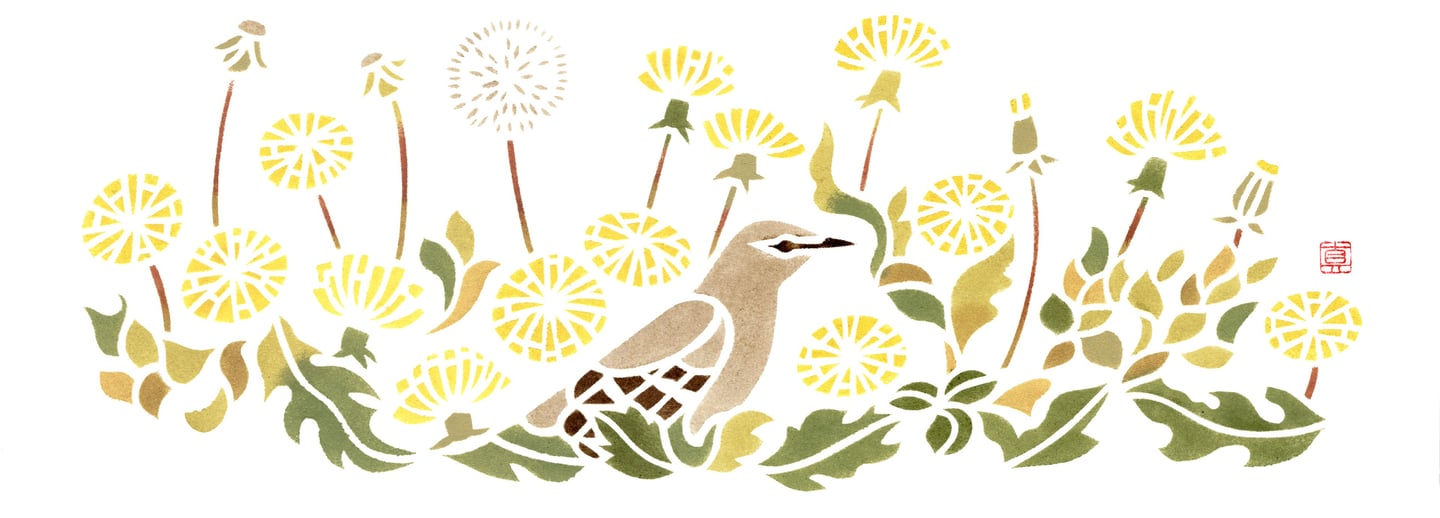
The illustrations in this zine were made with hand-cut stencils and painted with pigments from 20 species of invasive plants and weeds. The species include: Autumn Olive, Bittersweet Nightshade, Broad-leaved Dock, Brown Knapweed, Butterbur, Canada Thistle, Common Buckthorn, Corn Speedwell, Dame’s Rocket, Garlic Mustard, Honeysuckle, Japanese Barberry, Knotweed, Mugwort, Multiflora Rose, Orange Daylily, Orchard Grass, Oriental Bittersweet, Privet, and Toringo Crabapple.
Physical Copy Distribution
Hawthorne Valley Farm Store / Green Acres Farm Store / Arhur's Point Farm / Mud Creek Environmental Learning Center / North Chatham Free Libary / Hudson Area Library / Claverack Library / Roe Jan Library / Valatie Library / Chatham Library / Olana gift shop and education center / Columbia Land Conservancy office / Old Books / Restore Hudson / Auto Tech Solutions / Random Harvest / Columbia County Tourism Office / Dove's Diner / Tiny Town / Taste NY Capital Region Center


Columbia County
Dutchess County
Rose Hill Farm / Oblong Millerton, Rheinbeck / Amenia Free Library
Greene County
Wave Farm / Cafe Joust
Ulster County
Hudson Valley Farm Hub / Hurley Library / Kingston Library / Chicory Naturalist / Curious Kingston
Please feel free to get in touch with me if you'd like to carry some free copies of Beakuency zine!
Support this work!
Donate
This zine is a labor of love! The grant covered the printing costs, but everything else is out of pocket. If you liked this zine, click the button below to support me via Buy Me a Coffee. You can also become a paid subscriber at beakuency.substack.com or send a tip via Venmo (@mayukof).
Share Your Thoughts
I’d love to hear what you thought about this zine! Your feedback will also help fulfill my reporting requirements for the grant that funded this project. Click the button below for a quick survey. Thank you!
Acknowledgement
Beakuency: Bird-Friendly Farms in Hudson Valley!, is a community-engaged art project informed by the expertise of Cornell Cooperative Extension of Columbia and Greene Counties. It offers hands-on workshops and a free art zine to highlight local agricultural conservation and explore coexistence. Invasive plants and weeds are used as teaching materials in the workshops and to create all illustrations in this zine. The materials are collected through local land management practices aimed at restoring ecological balance, which also benefits bird populations.
This project is made possible with funds from the Statewide Community Regrant Program, a regrant program of the New York State Council on the Arts with the support of The Office of the Governor and the New York State Legislature and administered by CREATE Council on the Arts.